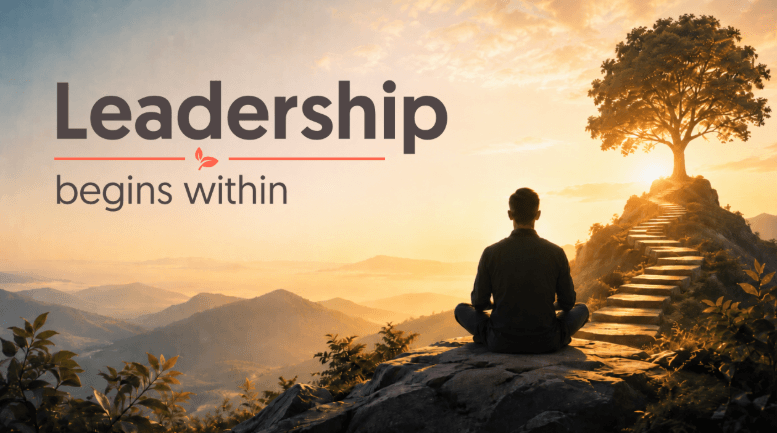
Leadership
Leadership Begins Within
Leadership is often discussed in terms of strategy, execution, growth and results. We admire leaders who make bold decisions, navigate uncertainty, build successful organizations and inspire people around them. Yet, in many of these conversations, one important dimension is often overlooked: The inner world of the leader.
Leadership is often discussed in terms of strategy, execution, growth and results. We admire leaders who make bold decisions, navigate uncertainty, build successful organizations and inspire people around them. Yet, in many of these conversations, one important dimension is often overlooked: The inner world of the leader.
Every decision a leader makes is influenced not only by data or experience, but also by their emotional state, their ability to remain present, and the clarity with which they see a situation. We spend years learning how to manage businesses, but very little time learning how to manage ourselves. Funny, isn't it, we'll happily sit through a three-day workshop on quarterly forecasting, but ask someone to sit quietly with their own mind for ten minutes and suddenly everyone's "too busy."
For many years, I didn't understand this either.
There was a period in my life when I had very little awareness of my inner world. Like many people, I was reacting to whatever was happening around me. External situations determined my emotional state, and my decisions often came from that place of reaction.
Things began to change when I experienced meditation and mindfulness.
What surprised me most was not that I became calmer. It was that I became more effective.
I never dialed down my intensity. If anything, my intensity increased. Before beginning these practices, I had assumed that slowing down internally might make me less ambitious or less goal-oriented: that I'd wake up one day, cross-legged, and no longer care about the P&L. The opposite happened.
I became more present.
I worked the same number of hours, but accomplished significantly more within those hours. Decisions became clearer. I found myself responding from a more mature place rather than reacting emotionally. Somewhere along the way, I became less driven by fear and more guided by awareness.
People often ask whether mindfulness makes leaders softer. My experience has been that it makes them sharper, turns out "zen" and "sharp" aren't opposites.
Presence is a leader's greatest advantage
When you are completely present, your attention is no longer divided between yesterday's regrets, tomorrow's anxieties, and today's meeting. You are fully in the moment. The decisions you make become more thoughtful. The conversations become more meaningful. You listen differently.
Leadership is not only about speaking well. It is equally about listening deeply, a skill in surprisingly short supply in a room full of people waiting for their turn to talk.
One of the greatest challenges leaders face today is not the complexity of business itself, but the constant pressure to react. Markets change. Teams face uncertainty. Expectations continue to rise. Under those circumstances, the instinct is often to respond immediately, usually followed, twenty minutes later, by the instinct to regret it.
Yet some of the biggest mistakes I have made in my life came when I made decisions while emotionally charged.
My father would often tell me, "Don't make decisions when you are emotionally charged."
I learned the wisdom of that advice the hard way, as, apparently, does everyone, which is why fathers keep repeating it.
Leadership is not about delaying decisions unnecessarily. It is about creating a small pause between what happens and how we respond. That pause often changes everything. When we cultivate self-regulation, we still make decisions quickly, but they come from clarity instead of reactivity.
One simple practice that has helped me is something called the 5-4-3-2-1 grounding exercise. Before entering an important meeting, I consciously bring myself into the present by noticing what I can see, touch, hear, smell, and taste. It sounds simple, and honestly, a little strange if someone catches you sniffing the air outside a boardroom. But it has an extraordinary effect. Instead of entering a meeting carrying mental clutter from everything that came before it, you enter fully present.
Great leaders have the ability to look deeply. And the more deeply you can look, the better choices you make. In fact, I often say that a great leader is someone who can look further. The further you can see, the further you can go.
Leadership also becomes easier when we stop believing that every challenge must be controlled.
During the COVID-19 pandemic, I worked closely with an organization that lost 94 percent of its revenue almost overnight. Fear would have been the natural response and frankly, it would have been the reasonable response. Instead, the leadership chose fearlessness, vulnerability, and mindfulness. Over the next two and a half years, they not only recovered but experienced more than 300 percent growth by creating new products and new services.
That experience reinforced something I have observed repeatedly: inner work changes outer results.
Hard work, smart work, effortlessness
Many people think success comes only through working harder. Hard work certainly has its place, but leadership evolves through stages.
First comes hard work. Then comes smart work. Eventually comes effortlessness.
I often explain this through the analogy of a river. Hard work is swimming against the current. Smart work is swimming with the current. Effortlessness is sitting in a boat, moving with the river, while still travelling in the same direction, which, if you've ever watched someone "hustle" their way upstream for a decade, is a much nicer way to arrive at the same destination.
Effortlessness does not mean doing nothing. It means that your work begins to flow naturally because you are aligned with your purpose, you trust the people around you, you delegate well, and you stop trying to control everything. There is more creativity. More sharing. Less unnecessary control. Ironically, you often accomplish much more - the universe's small joke on control freaks everywhere.
Embracing uncertainty
Another lesson leadership has taught me is the importance of embracing uncertainty. We spend enormous amounts of energy trying to make life predictable. Yet uncertainty is not a problem to solve, it is a truth to accept.
The teachings of the Buddha have deeply influenced my thinking here. Everything is impermanent. Projects end. Companies evolve. Ideas change. Success passes. Failure passes too.
When leaders truly understand impermanence, uncertainty stops feeling like a burden. Instead of demanding calm waters, they learn to surf the waves. There will always be highs and lows. The goal is not to eliminate them but to develop the ability to move through them with balance.
Perhaps that is where real confidence comes from.
Confidence is often misunderstood. Sometimes it is simply appearance, how we speak, how we dress, or how certain we sound. (We've all sat across from someone who sounded extremely confident and was, in hindsight, extremely wrong.) Real confidence is different. It comes from being deeply aligned with your purpose.
The same is true of clarity. Clarity does not come from thinking harder. It comes from a quieter mind.
A leader may appear confident on the outside while feeling deeply uncertain within. Lasting leadership is built when confidence and clarity arise from within rather than being projected outward.
The one shift every leader should make
Spend as much time working on yourself as you spend working on your business.
Most people are constantly trying to improve their teams, their organizations, their revenues, their balance sheets, and even their social media presence. Very few invest consistently in improving the person making all those decisions: the one variable, curiously, that shows up in every single meeting.
It does not require dramatic change.
Start with ten minutes of silence or meditation. Ten minutes of reading something meaningful. Ten minutes with people who are committed to self-reflection rather than blame.
It is a simple practice, but over time it changes how you think, how you lead, and how you live.
Leadership is ultimately not about controlling the world around us. It is about understanding the world within us. When the inner world becomes clearer, the outer world often begins to change on its own.